




From Bicycle to E-Trike: A Safe Riding Guide for Older Adults
As we age, many of us look forward to taking a slow ride outdoors again—enjoying fresh air, visiting friends, or simply cruising around the neighborhood. Yet the fear of losing balance, falling, or dealing with sore knees often keeps us indoors. Riding a bicycle may feel intimidating now: perhaps you think, “If I try that e-bike, I’ll end up in the hospital.” The truth is: trikes are not just “three-wheeled bikes.” They behave differently—and that’s a good thing if you know how to ride them.
---
In this guide you’ll learn how to transition safely from thinking like a bicyclist to riding like a trike rider—with less strain on your body, more stability, and more freedom.
---
1. Understanding the Difference: A Trike Is Not a Bicycle
When you ride a bicycle, your brain and body use muscle memory: you lean into turns, you shift your balance, you naturally “feel” the lean. That intuitive feeling disappears with a trike. A three-wheel vehicle stays upright—always.
• On a bicycle you lean; on a trike you stay upright.
• On a bicycle you may tip slightly and recover; on a trike tipping is much harder to correct.
• On a bicycle you can make tight turns; on a trike the turn radius is usually wider and you must take turns slower.
One rider’s story: “My mother-in-law was fine on a bike until she faced a parking lot entrance—one slight tilt pulled her outward, she tried to correct, and she fell into a ditch.” That kind of scenario is exactly why we say: you must unlearn some bicycle habits before jumping on a trike.
Key practice tips:
Do not lean your body into a turn.
Enter curves slowly—reduce speed before turning.
Practice on a flat, smooth surface until your trike controls feel second nature.
---
2. Why Many Older Adults Prefer Trikes: Comfort, Stability, & Health
Two-wheeled bikes may be fun, but for older riders they often come with frustrations: sore knees, wobbly starts, fear of tipping, especially on uneven roads. A well-designed e-trike changes all that.
Comfort & Health Benefits
The upright seating position reduces strain on your knees, hips, and back.
You don’t rely on balancing your body—so less stress on joints or weak legs.
Electric assist means you don’t have to push hard, climb hills unaided, or struggle with heavy loads.
Stability & Terrain Handling
Three wheels give you instant stability, even when stopped.
On bumpy, cracked roads or dirt with potholes—common in rural areas—you’ll feel steadier.
If your balance isn’t what it used to be or your vision isn’t perfect, the secure platform of a trike gives you confidence.
Freedom & Practical Use
With a cargo rack or rear bench seat you can carry groceries, a pet, or a passenger—no backpack strain needed.
Trikes make errands easier, visiting friends possible again, and spontaneous outings far more comfortable.
---
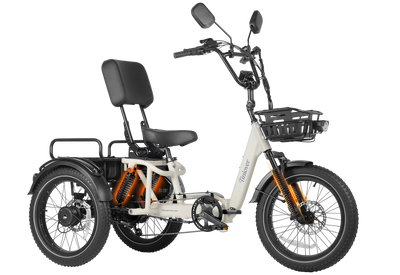
3. Meet the Tiniover Creek Pro — Designed for Ride-Everyday Confidence
When you are choosing a trike, you’ll want to look for features that address the real concerns of older riders. The Tiniover Creek Pro was built with this in mind.
20Ah battery: gives you long-range support so you can ride for errands, park visits, or a gentle afternoon—without battery anxiety.
750 W motor: strong enough to climb neighborhood hills yet smooth and safe at lower speeds; great for older adults who don’t want to struggle uphill.
Hydraulic disc brakes on all three wheels: provides superior stopping power and control—essential when you want to feel safe, not stressed.
Cargo + passenger adaptability: switch between rear rack for shopping or bench seat for a passenger easily—so the vehicle adjusts to your lifestyle, not the other way around.
With these features, you’re not buying speed—you’re buying,a trike that supports your life and your limitations, built so you don’t compromise your comfort, your joints, your balance.
---
4. Getting Started: Safe Practice Routine for Older Adults
Here’s a simple routine to build your confidence:
1. Choose a flat, smooth driveway or quiet street—minimum slope.
2. Sit down on the trike, push off gently and let the motor assist you to a modest speed (say 5-7 mph).
3. Practice the hill-parking mode: stop on a gentle slope, engage it, feel how the trike locks.
4. Practice slow turns—enter at low speed, do not lean. Notice how the vehicle tracks.
5. Gradually add small loads (shopping bags or a pet basket) to get used to the higher mass.
6. When comfortable, test a gentle slope uphill—keep your speed moderate, use the throttle, and feel how the motor helps you.
Be patient. Within a week or two of daily short rides, many older riders feel ready to take errands, go for a park ride, or visit friends.
5. Final Thoughts: Slow Down, Ride with Confidence
If you approach a trike thinking “I’ll ride like a bike,” you’re setting yourself up for frustration or fear. But if you accept that a trike is a different tool—one designed for stability, comfort, and freedom—you’ll find yourself rediscovering joy in riding again.
Comfort over speed, confidence over daring, stability over leaning—that is what matters after 50. With the right equipment (like the Tiniover Creek Pro) and a few gentle practice rides, you can reclaim your independence, ride again with less worry, and enjoy the outdoors on your terms.