




California’s New E-Bike Regulations: What Do They Mean for Electric Tricycles?
California has introduced major updates to its e-bike laws, and they’re reshaping how different types of electric bikes are classified and used.
Until now, e-bikes have been grouped into three familiar classes based on how their motors assist riders and how fast they can go:
- Class 1: Pedal-assist only, with a top speed of 20 mph.
- Class 2: Equipped with a throttle, allowing motor-only operation up to 20 mph.
- Class 3: Pedal-assist only, but capable of reaching 28 mph.
The new rules, however, bring a significant shift. Under the revised legislation, Class 1 and Class 3 e-bikes are no longer allowed to have working throttles. In other words, even if an e-bike offers pedal assist, it can’t legally operate on throttle power alone.
At the same time, motor output is now strictly limited to 750 watts across all e-bike types—removing the previous flexibility around “continuous power.”
Lawmakers say these changes aim to improve rider safety and control excessive speeds. But for many e-bike owners—and especially those who rely on throttles for comfort or accessibility—the new restrictions could make everyday riding more complicated.
Impact on Electric Tricycles
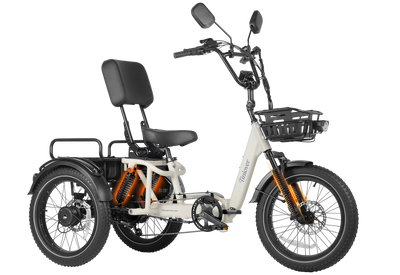
Electric tricycles fall under similar rules as electric bikes when it comes to speed limits, power output, and throttle functionality. Fortunately, California’s updated e-bike regulations are expected to have only a limited effect on the tricycle segment. Most e-trikes on the market are already designed to travel at a top speed of around 20 mph, which naturally fits within both safety expectations and rider comfort levels.
This moderate speed aligns well with the trike’s three-wheel stability — higher speeds are not only unnecessary for most users but can also become harder to control safely. The focus on a 20 mph design limit strikes a healthy balance between performance, stability, and safety, particularly for older riders who value confidence and control over raw speed.
Potential Limitations on Innovation
However, California’s tighter regulations could have a chilling effect on innovation across the e-trike industry. Many manufacturers have been actively developing new models with improved range, stronger motors, and greater load capacity, as well as exploring technologies like enhanced suspension systems and smart throttles.
With these new restrictions in place, companies may need to redirect engineering resources toward ensuring compliance—verifying that every model meets the 750W power cap and adheres to throttle limitations—instead of investing in bold new upgrades. Over time, this could slow the pace of progress, particularly in areas like hill-climbing performance or heavy-duty cargo capacity, where higher torque and throttle control make a meaningful difference.
For example, tricycles designed for hilly regions or delivery use often rely on stronger motors to maintain consistent power under load. The new power ceiling could limit such capabilities, making it more difficult for brands to differentiate or optimize for specific use cases without exceeding the legal threshold.
Conclusion
In summary, while California’s new e-bike laws are unlikely to disrupt most electric tricycle models currently on the market, they may create challenges for future innovation. Standard e-trikes that already conform to the 20 mph and 750W limits will continue operating without issue.
However, for models that aim to push boundaries—offering faster performance or greater hauling power—manufacturers may now face a tighter design box. Over time, these legal constraints could shift industry priorities away from performance upgrades and toward compliance-first engineering, potentially slowing the introduction of more advanced or specialized electric tricycles in the U.S. market.